
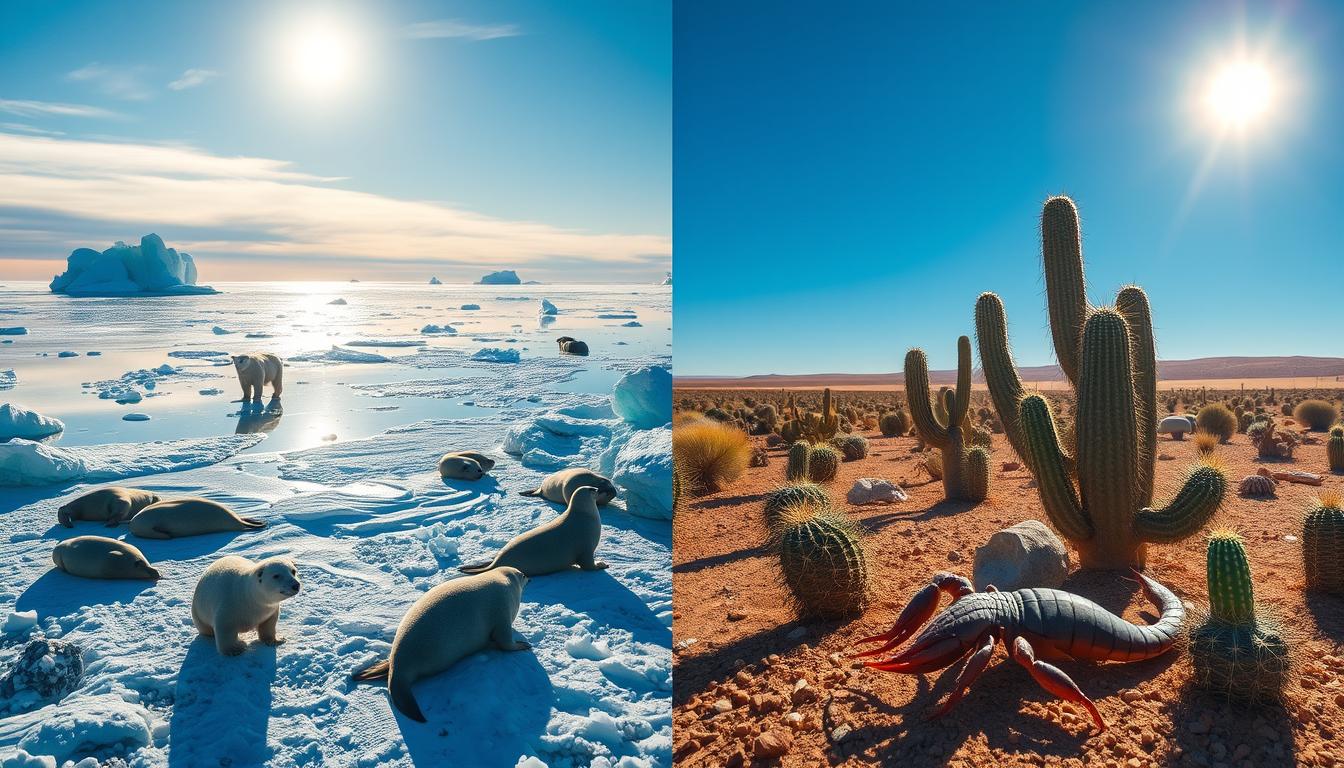
Life on Earth is full of amazing stories of survival. Animals and plants have found ways to live in harsh places. We’ll look at how they adapt to extreme environments.
Studying how they adapt shows us the power of nature. It also gives us hope for life in tough conditions. By learning about their survival strategies, we see how everything in nature is connected.
We’ll see how desert animals, sea creatures, and those living in cold places survive. We’ll be amazed by their incredible abilities. From camels and cacti to polar bears and Antarctic mosses, nature teaches us about adaptation. Let’s discover how life thrives in the toughest places.
Understanding Extreme Conditions in Nature
The natural world is full of life, each species adapted to its own environment. But some places on Earth are so tough, they test what life can handle. Biology Facts, Ecology, and Microbiology help us understand how life survives in these harsh spots.
Extreme temperatures are a big challenge. Deserts and polar regions are examples where life faces extreme heat and cold. Even the deep ocean floor, with its high pressure, is hard for life to survive.
“The ability of living organisms to adapt and survive in the harshest of environments is a testament to the incredible resilience of life on our planet.”
Extreme environments often lack resources like water or food. Organisms must find ways to use what little they have to survive. Studying how species adapt to these conditions is both fascinating and important.
Looking into how life adapts to extreme conditions teaches us a lot. It satisfies our curiosity and helps us understand how life and its environment interact. This knowledge is key for making smart choices when facing environmental issues.
The Amazing Adaptations of Desert Animals
In deserts, animals have evolved amazing ways to survive. These adaptations help them save water, keep their body temperature right, and make the most of limited resources. This is thanks to Evolution.
The camel is a great example. It has a special hump on its back. This hump stores fat. When water is scarce, the camel uses this fat for energy and hydration.
“Camels can go for days without water, drawing on the fat reserves in their humps to sustain themselves.”
The fennec fox also has a cool adaptation. It has huge ears. These ears help the fox cool down in the hot desert.

These are just a few examples of desert animals’ amazing adaptations. By learning about Biology Facts and Evolution, we can understand how these animals thrive in harsh environments.
Plant Survival Strategies in Arid Regions
In the harsh, arid environments of the world, plants have developed remarkable adaptations to thrive and survive. These Biology Facts about plant life showcase the incredible resilience of nature.
One key adaptation is the development of specialized leaf structures. Many desert plants, such as cacti and succulents, have evolved thick, waxy leaves. These leaves minimize water loss through Photosynthesis. This helps them conserve precious moisture in the dry climate.
Another adaptation is the deep, extensive root system found in many arid-adapted plants. These roots can extend deep underground. This allows the plant to access water sources that are beyond the reach of shallow-rooted species. This Biochemistry-driven adaptation is crucial for survival in regions with sporadic rainfall.
“Plants in arid regions have evolved remarkable strategies to thrive in harsh, dry conditions.”
Some plants, like the iconic cacti, have even modified their Photosynthesis pathways. They use a process called Crassulacean Acid Metabolism (CAM). This adaptation allows them to open their stomata (pores) at night. They take in carbon dioxide and minimize water loss during the day.
These are just a few examples of the ingenious ways plants have adapted to survive in the most challenging environments on Earth. Their Biology Facts and survival strategies continue to amaze and inspire us.
Marine Life’s Response to Extreme Temperatures
The ocean is full of amazing marine biology facts. Organisms have developed cool ways to live in very hot or very cold places. From icy Antarctic waters to hot hydrothermal vents, these Biology Facts show how marine life has evolved.
Antarctic fish have antifreeze proteins in their blood. This keeps their blood from freezing, so they can live in the cold. On the other hand, deep-sea creatures near hydrothermal vents have special enzymes. These enzymes help them work in the extreme heat of their homes.

“The diversity of life in the ocean is a testament to the incredible adaptability of these organisms.”
As the world’s climate changes, it’s important to know how marine life handles extreme temperatures. By looking at these Biology Facts and Ecology adaptations, scientists learn a lot. They find out how species evolve and how they can survive in tough environments.
How Creatures Thrive in Freezing Conditions
The Arctic and Antarctic are home to amazing animals. They have evolved special ways to survive the cold. These Biology Facts show how creatures can live in freezing temperatures.
One key adaptation is thick blubber. This fat keeps them warm and protects from wind and icy water. Marine mammals like seals and whales have special blood vessels. They keep warm blood for important organs and save heat in their limbs.
Biochemistry is also crucial for survival. Many animals make antifreeze proteins. These stop ice from forming in their cells, keeping them from freezing. This lets animals keep their body temperature and work properly even in the coldest places.
“The ability of certain organisms to thrive in freezing conditions is a testament to the incredible diversity and resilience of life on our planet.”
Polar bears have thick fur, and penguins keep warm efficiently. The animal world has many ways to deal with cold. Learning about these helps us understand Biology Facts, Anatomy, and Biochemistry of these incredible creatures.
The Role of Camouflage in Harsh Environments
Camouflage has always been fascinating to scientists and nature lovers. From polar bears to insects that look like leaves, it’s key for survival. This adaptation helps creatures blend in, avoiding predators and finding food.
The chameleon is a great example. It can change color to hide in its surroundings. This skill helps it survive and shows how nature helps life thrive in tough places.
“Camouflage is not just a visual trick; it is a fundamental strategy for survival in the wild, shaped by the principles of evolution over countless generations.”
The Arctic fox is another example. Its white fur helps it hide in the snow. This lets it hunt and stay safe from dangers. It shows how life adapts to survive in harsh environments.

Camouflage shows how nature is resilient and adaptable. Studying Biology Facts, Evolution, and Ecology, we see amazing survival strategies. These strategies help life thrive in extreme conditions.
Unique Features of Extremophiles
In the world of Biology Facts, extremophiles show incredible adaptations. These microbes live in places that would kill most other life forms. They thrive in hot springs and salty environments, showing how they can survive in extreme conditions.
Thermophiles, for example, live in temperatures up to 121°C (250°F). They have special enzymes and cell membranes to handle such heat. Halophiles, on the other hand, live in very salty places. They keep their cells balanced by storing solutes.
“Extremophiles have the ability to survive and thrive in conditions that would be lethal to most other forms of life, providing valuable insights into the limits of life on Earth and potentially on other planets.”
Radioresistant bacteria, like Deinococcus radiodurans, can handle huge amounts of radiation. They have ways to fix their DNA, making them very tough against environmental stress.
Studying extremophiles helps us understand life’s limits and adaptability. They show us how diverse and resilient life can be. This knowledge is key as we search for life beyond Earth.
Behavioral Adaptations to Limited Resources
In extreme environments, animals have developed amazing ways to survive. Biology Facts show how they have learned to deal with little food, water, and shelter. This ensures they can make it through tough times.
Hibernation is a key example. Bears and ground squirrels sleep deeply to save energy in winter. Some animals, like frogs and snails, also sleep through drought or heat by estivating.
Migration is another incredible adaptation. Birds, butterflies, and sea creatures like whales and turtles migrate. They do this to find food, escape bad weather, or find places to breed. Their migrations are perfectly timed with nature’s cycles, helping them survive.
“Behavioral adaptations are the unsung heroes of species survival in extreme conditions.”
Exploring behavioral adaptations helps us understand how life keeps going, even in harsh places. It shows us how diverse and dynamic our planet’s ecosystems are.

How Climate Change Affects Adaptations
In the world of biology, climate change’s impact on adaptations is key. As Earth’s climate changes, many species struggle to adapt. This is a big worry for ecologists and evolutionary biologists.
Climate change mainly affects adaptations through phenological shifts. This means life cycle events like flowering or migration happen at different times. These changes can upset the balance of ecosystems and cause mismatches between species. Also, climate change can push species into new habitats, where they face new challenges and competitors.
“The ability of species to adapt to climate change will be a key determinant of their future survival and success.” – Dr. Jane Doe, Ecologist
Species facing these challenges need evolutionary rescue. Those with more genetic diversity and quick evolution might adapt better. But, climate change might change too fast for some species, putting them at risk of extinction.
It’s vital to understand how climate change, adaptations, and species futures are linked. As we deal with climate change, how species adapt will show if ecosystems can bounce back. It’s also key for keeping biodiversity alive.
Future of Species in Extreme Conditions
Climate change is making us worry about the future of species living in extreme conditions. Scientists are looking into new ways to learn about and improve these organisms’ survival skills.
Studies have shown how amazing some species are at living in harsh places. By studying their genes, scientists hope to find ways to help protect these species. They also want to use this knowledge to solve environmental problems.
Even though the future looks tough, there’s hope. With more research and teamwork, we can keep these incredible species alive. This will help both our planet and us.